

Skip Navigation.

Mandal Research Group

photo of Maumita Mandal

Maumita Mandal
Assistant Professor
Department of Chemistry
Carnegie Mellon University
Mellon Institute Room 756
4400 Fifth Avenue
Pittsburgh, PA 15213-3890

Phone (412) 268-4213
Fax (412) 268-1061

mandal@cmu.edu

Biophysical Chemistry of Nucleic Acids

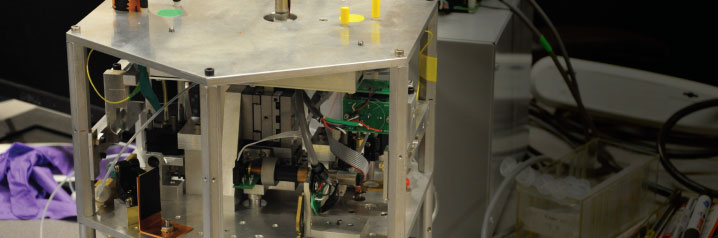
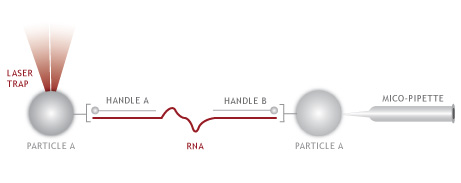
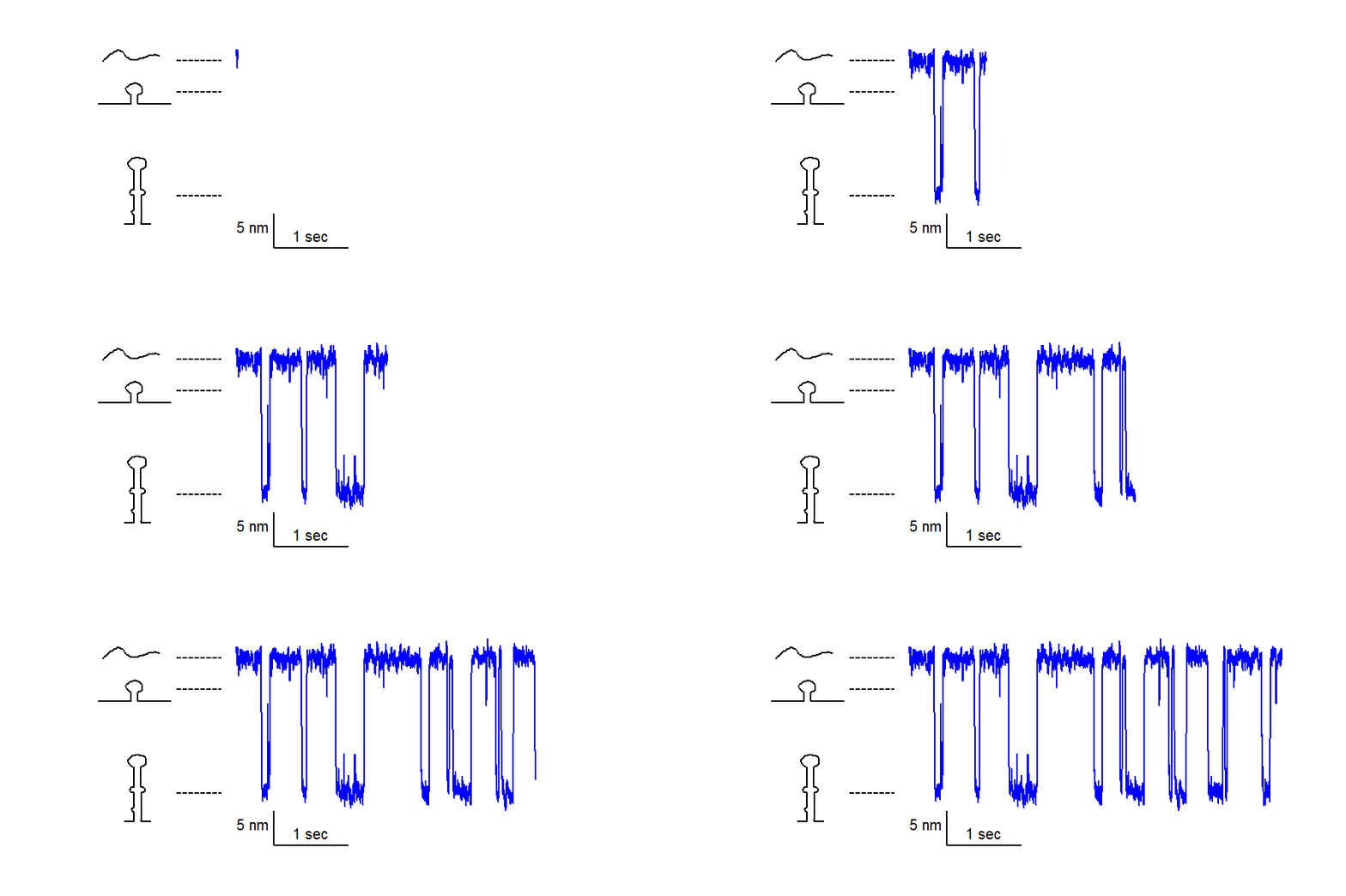
Our laboratory uses a combination of biochemistry, biophysics, and single-molecule approaches to investigate RNA structure and conformational rearrangements. RNA rearrangements are important in gene regulation, splicing, translational synthesis by ribosomes and several other RNA-based molecular motors. To get a complete understanding of a native conformational state under physiological conditions, it is important to dissect the multiple steps of RNA folding, as any deviations may lead to misfolding and cellular pathologies. However, it is often difficult to identify the folding intermediates that are crucial for the formation of a functional complex by biochemical methods alone. Single-molecule detection methods have recently emerged as a powerful tool to monitor the behavior of individual biological molecules in real time. We use optical-tweezers to manipulate single-molecules of RNA by mechanical force, and study their real time kinetics under normal cellular conditions and in the disease state.

Of particular interest to our study is the structural rearrangement in riboswitches. Riboswitches are complex structural domains in the 5'-untranslated region in mRNAs that bind to small molecule metabolites and undergo conformational rearrangements in the adjacent region. This results in an altered expression of the downstream gene which may be down-regulated or up-regulated or even may affect the mRNA stability. We study how RNA folds into intricate structures to bind specific cofactors and how the structural rearrangement help perform the biological functions in real time. Our past accomplishments with guanine-riboswitch in this direction show, how the ligand binding is energetically coupled to form a native state. We are developing novel single-molecule assays to detect this rearrangements in other molecules that are important for gene regulation.

Our current research is focused in the following areas:

Courses: Introduction to Biophysical Chemistry (09-802)

Chemistry (09-802) is a special topics course designed to introduce graduate and senior undergraduate students from chemistry, physics, biology or any other related discipline who are interested in structural biology and molecular biophysics of nucleic acids and proteins.

Available Positions

Postdoctoral, Graduate and Undergraduate Research Opportunities

Selected Publications:

  1. Mandal, M., Smith S.B., Tinoco, Jr. I. and Bustamante, C.
    Guanine riboswitch follows a modified induced-fit allosteric mechanism to control gene expression. (Manuscript submitted).
  2. Mandal, M., Lee, M., Barrick, J.E., Weinberg, Z., Emilsson, G.M., Ruzzo, W.L., Breaker, R.R
    A glycine dependent riboswitch that uses cooperative binding to control gene expression. Science. (2004), 306, 5694:275-279.
  3. Mandal, M., Boese, B., Barrick, J.E., Winkler, W.C., Breaker, R.R.
    Riboswitches control fundamental biochemical pathways in Bacillus subtilis and other bacteria. Cell. (2003), 113 (5): 577-86.
  4. Barrick, J.E., Korbino, K.E., Winkler, W.C., Nahvi, A., Mandal, M., Collins, J., Lee, M., Roth, A., Sudarsan, N., Jona, I., Wickiser, J.K., Breaker, R.R. New RNA motifs suggest an expanded scope for riboswitches in bacterial genetic control. Proceedings of National Academy of Sciences, USA. (2004), 101, 17, 6421-6.